 Skip to content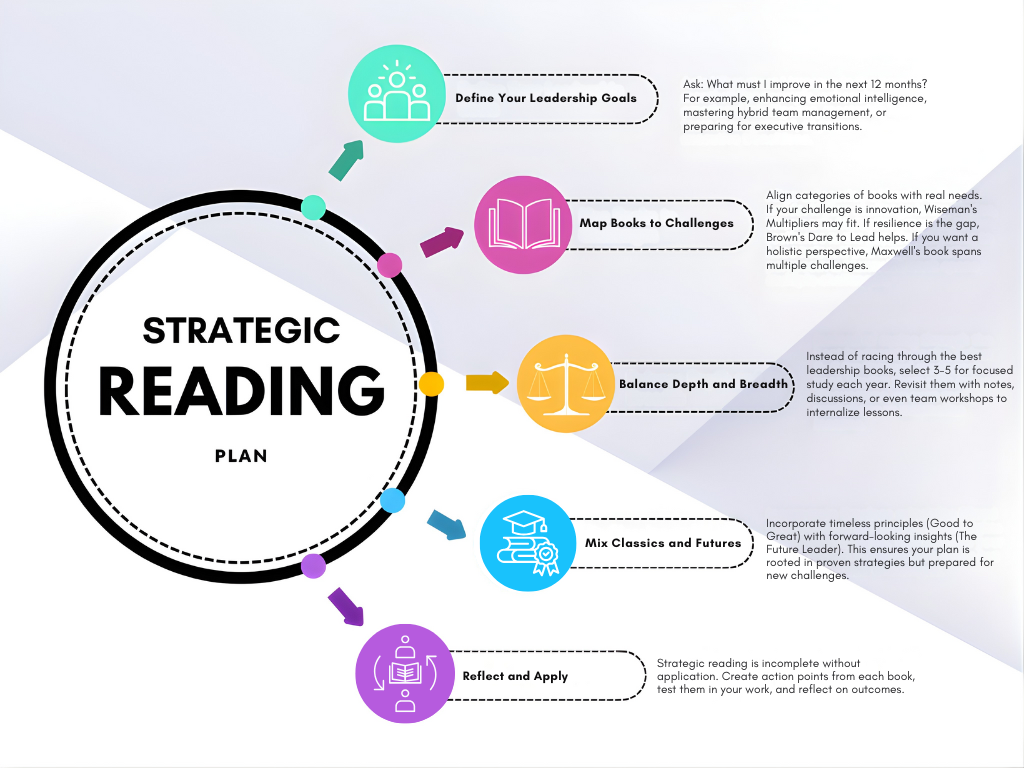
In every era, leaders have turned to books for wisdom, clarity, and inspiration. But in today’s fast-growing world—where artificial intelligence, hybrid work, global challenges, and social transformation redefine what leadership means—simply browsing through the best leadership books is no longer enough. The true advantage lies in building a strategic reading plan—a thoughtful, intentional approach that ensures you not only consume information but also integrate it into your leadership journey.
This blog goes beyond static lists. It offers a framework for creating a personalized leadership reading plan anchored in the best books about leadership and practical insights. Together, these resources will help you design a reading strategy that develops with your career, aligns with your leadership style, and adapts to the future of work.
Why a Strategic Reading Plan Matters
For leaders, time is limited. Between meetings, strategic decisions, and guiding teams, the luxury of endless reading simply doesn’t exist. That’s why random reading—even if it includes some of the best leadership books—often yields little long-term benefit. Without a strategy, knowledge doesn’t connect, lessons fade, and insights remain abstract rather than actionable. A strategic reading plan transforms scattered learning into structured growth. It allows you to:
- Align reading with your career stage and leadership goals.
- Balance timeless classics with emerging insights for 2025 and beyond.
- Apply lessons to real challenges in your organization.
- Avoid “intellectual clutter” by focusing on depth rather than volume.
- Build habits that make reflection and implementation as important as reading itself.
You must be aware of how to choose the right book for your leadership style in order to effectively learn how leadership development books works.
The Core Categories of Leadership Reading
To build a reading plan, it helps to group books into categories that map onto real leadership challenges. The following framework integrates Colin Maxwell’s perspective with modern leadership demands.
1. Foundational Leadership Principles
Every leader needs grounding in ethical decision-making, communication, motivation, and self-awareness. These are the pillars that guide all other skills. Books like Good to Great by Jim Collins or Mindset by Carol Dweck create this foundation.
2. Adaptive and Future-Oriented Leadership
With rapid change, leaders must stay ahead of trends. Colin Maxwell’s Leadership: 21st Century Food for Thought is especially relevant here, addressing AI, remote work, Japanese management lessons, and crisis readiness. It shows how leaders can treat AI as an augmentation, not a replacement, and build continuity plans for unpredictable disruptions.
3. People and Culture Building
Culture, inclusion, and team trust shape whether strategy succeeds. Best leadership books like Multipliers by Liz Wiseman and The Culture Code by Daniel Coyle guide leaders in building environments where people feel safe, creative, and motivated.
4. Personal Growth and Resilience
Leaders are not immune to burnout, self-doubt, or decision fatigue. Titles like Dare to Lead by Brené Brown and The Infinite Game by Simon Sinek emphasize resilience, authenticity, and purpose—reminders that leadership is as much about inner strength as outer impact.
5. Practical Transitions and Execution
Whether stepping into a new role or tackling an organizational shift, leaders need practical handbooks. The First 90 Days by Michael Watkins is a classic resource for navigating transitions effectively.
By mapping and reading into these categories, you prevent being overwhelmed and ensure balance. Instead of passively working through “the best books for leadership,” you’ll build a roadmap tailored to your goals.
Colin Maxwell’s Contribution: Leadership in the 21st Century
Maxwell’s Leadership: 21st Century Food for Thought deserves a central place in any strategic reading plan. Unlike many books that focus only on corporate profitability or charisma, Maxwell combines ethics, servant leadership, diversity, and technology into a cohesive framework. Some of the book’s most compelling takeaways include:
- The Japanese Method:
Emphasizing kaizen (continuous improvement), just-in-time efficiency, and consensus-based decision-making. These lessons remind leaders that discipline, culture, and trust are competitive advantages.
- Quality Circles:
Practical examples of empowering small groups to identify and solve problems, scaling innovation from the ground up.
- Crisis Readiness:
Encouraging leaders to view business continuity planning as an ongoing discipline, not a one-time exercise.
- Ethics as Strategy:
Arguing that morality and transparency are not optional extras but the foundation of sustainable leadership.
- AI as Partner:
Stressing that artificial intelligence is a tool to enhance—not replace—human judgment and creativity.
This makes Maxwell’s work not only one of the best books to read about leadership, but also a bridge between timeless wisdom and emerging challenges. His insistence on “servant leadership” places people at the center, while his embrace of AI and global cultural intelligence positions leaders to thrive in 2025 and beyond.
Extracting Wisdom from the Best Leadership Books
It’s tempting to view curated lists as the end of the journey. But they should be the beginning. You can find many exciting titles by typing “Best Books About Leadership in 2025,” so that you get to improve your leadership skills. Let’s explore a few of them:
- Leadership: 21st Century Food for Thought by Colin Maxwell.
- Multipliers by Liz Wiseman.
- Dare to Lead by Brené Brown.
- The Infinite Game by Simon Sinek.
- The Future Leader by Jacob Morgan.
Each of these books offers unique insights. However, the key is not reading them all at once, but weaving them into your development path. If you’re transitioning into a new role, Watkins’ The First 90 Days might come first. If you’re building culture, Coyle’s The Culture Code could be your priority. If your challenge is ethical decision-making in a global context, Maxwell’s book is your anchor.
For a deeper dive into methods of leadership growth—mentoring, 360-degree feedback, and stretch assignments—many blogs on guide to leadership development provide actionable frameworks. Pairing that with the curated book list creates a system: books for knowledge, structured development for practice.
Building Your Strategic Reading Plan: A Step-by-Step Framework
Here’s how to turn lists into a customized, actionable plan:
Step 1: Define Your Leadership Goals
Ask: What must I improve in the next 12 months? For example, enhancing emotional intelligence, mastering hybrid team management, or preparing for executive transitions.
Step 2: Map Books to Challenges
Align categories of books with real needs. If your challenge is innovation, Wiseman’s Multipliers may fit. If resilience is the gap, Brown’s Dare to Lead helps. If you want a holistic perspective, Maxwell’s book spans multiple challenges.
Step 3: Balance Depth and Breadth
Instead of racing through the best leadership books, select 3–5 for focused study each year. Revisit them with notes, discussions, or even team workshops to internalize lessons.
Step 4: Mix Classics and Futures
Incorporate timeless principles (Good to Great) with forward-looking insights (The Future Leader). This ensures your plan is rooted in proven strategies but prepared for new challenges.
Step 5: Reflect and Apply
Strategic reading is incomplete without application. Create action points from each book, test them in your work, and reflect on outcomes.
Step 6: Reassess Annually
Leadership is dynamic. Each year, evaluate what you’ve learned, where gaps remain, and which of the top books to read on leadership in 2025 align with your next stage of growth.
Expanding Your Leadership Journey
A reading plan thrives when paired with structured development. That’s why it’s important to explore beyond this blog:
- For a step-by-step framework on how leadership evolves, see and learn what leadership development is and what the core leadership skills are that you require in the 21st
- For curated book recommendations, check the list of some of the best books on leadership, which will include titles like Radical Candor, The Culture Code, and Colin Maxwell’s Leadership: 21st Century Food for Thought.
These resources connect theory, practice, and strategy—helping you design not just a list but a living system of leadership growth.
The Role of Reflection and Community
The power of leadership books multiplies when combined with reflection, dialogue, and practical application. Our Essential 21st-Century Leadership Ethics Reading List provides a curated selection of books that guide ethical decision-making and transformative leadership. Consider forming a leadership reading circle with peers or team members to discuss how Maxwell’s principles of ethics can shape your workplace or how Brown’s lessons on vulnerability foster a culture of trust.
Pairing these readings with mentoring further accelerates growth. For instance, applying The Infinite Game in coaching sessions encourages long-term thinking, while workshops based on Multipliers enhance collaborative intelligence. This combination turns reading from individual enrichment into a shared organizational advantage, ensuring that ethical leadership principles are not only understood but lived.
Looking Ahead: Evolving Your Plan in 2025 and Beyond
The leadership challenges of 2025 are clear: AI integration, hybrid cultures, climate responsibility, and stakeholder capitalism. Leaders who thrive will be those who treat learning as a continuous process. Reading is not a checkbox—it’s an ongoing dialogue with ideas.
That’s why Colin Maxwell’s reminder to build “castles in the air, while ensuring they rest on solid foundations” resonates so deeply. Strategic reading allows you to dream big while grounding yourself in tested principles. As you design your plan, remember:
- Choose selectively from the best books to read about leadership rather than trying to consume everything.
- Apply lessons actively—leadership is a craft, learned by doing.
- Balance personal growth with organizational impact.
- Revisit and revise your plan regularly to match new realities.
Conclusion: Beyond the List
A list of the best leadership books is only the starting point. To truly grow as a leader, you must go beyond the list—crafting a plan that connects reading with practice, reflection, and evolving challenges. By anchoring your strategy in works like Colin Maxwell’s Leadership: 21st Century Food for Thought, integrating curated recommendations from our blogs, and linking lessons with structured leadership development, you create a living blueprint for continuous growth.
